“99 Out of 100” or “The Last 1%”
While raking leaves the other day, I was thinking about “the last one percent.”
Raking leaves, like much physical labor, is all about the most effective use of movement. In a sense, you could say it's about minimizing movement--getting the work done as quickly as possible with the least amount of effort. Engaged in this task, you think about things like the optimal pattern in which to rake the yard, how many times you bend to fill each wheelbarrow, etc.
So, in the process of minimizing my movements, I began thinking about “the last one percent,” or more informally, “just how clean does the yard need to be?” Do I pick up every single leaf? Do I pick up 90% of the leaves? 95%? 99%?
Of course, getting every leaf would only be possible through extraordinary (and foolish) effort … just as removing every drug dealer from the streets would be possible only at astronomical cost of money and human life ... just as guaranteeing that no person would ever again die in a car accident would make automobiles impossibly expensive and impractical to drive … choose any example you'd like. One hundred percent is the limit--the conceptual goal never to be realized but only to be approached. How close one gets depends on the cost one is willing to pay. This seems to be the way that the natural world operates.
However, I can think of situations when this “principle” is turned on its head. For example, in my business, housing, it seems that the last 1% of construction cost is where you really add the most perceived customer value. You can build a great building, with strong architectural integrity, intelligent planning, etc., but if the surface finishes in the kitchens and bathrooms aren't appealing, no one will buy. The other 99% of the building has to be built … there's no way around it. But without that last 1% of quality, the other 99% becomes much less valuable.
Another counter-example … something I've written about before, “the bottom of the bowl.” When you eat a salad, or a bowl of pasta, or whatever, the stuff that collects in the bottom is the best tasting stuff.
You hear the aphorisms, “god is in the details” or “the devil is in the details,” imploring us to be detail-oriented. You taste the stuff at the bottom of the bowl and realize how good it is. And yet nature and human social structures seem to operate in a way that makes attaining the last 1% impractical, even foolish.
I must think about this more … I can't yet reconcile these two interpretations.
It makes my caffeinated heart sing to know that there are many cafes and coffeehouses out there who can make an espresso drink 100x better than Starbucks. Here are two: Gimme! Coffee and Espresso Vivace. And I'm not so bad myself.
Mr. Micawber was waiting for me within the gate, and we went up to his room (top story but one), and cried very much. He solemnly conjured me, I remember, to take warning by his fate; and to observe that if a man had twenty pounds a-year for his income, and spent nineteen pounds nineteen shillings and sixpence, he would be happy, but that if he spent twenty pounds one he would be miserable. After which he borrowed a shilling of me for porter, gave me a written order on Mrs. Micawber for the amount, and put away his pocket-handkerchief, and cheered up.
Reading this article today made me think:
I live in a city with no population growth, no job growth; a city attempting to find its future. "Turning the economy around" in a city like this is a monumental effort. The last thing people here want to think about is all-encompassing social and economic change. They just want to know their job will be around next year.
With the income gap in this county widening, and many Americans going deeper into debt, one must ask the question: Is there a way to operate an economy that does not require growth? ...that does not require constant increases in consumer spending? ...that does not require those of lower income levels to go into debt so they may exist at the same standard of living as their neighbors?
I live in a city with no population growth, no job growth; a city attempting to find its future. "Turning the economy around" in a city like this is a monumental effort. The last thing people here want to think about is all-encompassing social and economic change. They just want to know their job will be around next year.
With the income gap in this county widening, and many Americans going deeper into debt, one must ask the question: Is there a way to operate an economy that does not require growth? ...that does not require constant increases in consumer spending? ...that does not require those of lower income levels to go into debt so they may exist at the same standard of living as their neighbors?
Sometimes you feel good about who you are.
Sometimes you don't feel good about who you are.
Sometimes someone you love makes you feel good about who you are.
Sometimes you accomplish something, and it makes you feel good about who you are.
Sometimes, someone else's asinine behavior makes you feel good about who you are.
"... Fully imagined cultural futures were the luxury of another day, one in which 'now' was of some greater duration. For us, of course, things can change so abruptly, so violently, so profoundly, that futures like our grandparents' have insufficient 'now' to stand on. We have no future because our present is too volatile. ... We have only risk management. The spinning of the given moment's scenarios. Pattern recognition."

Little Sally:
What is Urinetown?
Urinetown is here!
It's the "town" wherever
People learn to live in fear
So look around, you've finally found
The place you asked about
For Urinetown is your town
If you're hopeless down and out!
What is Urinetown?
Urinetown is here!
It's the "town" wherever
People learn to live in fear
So look around, you've finally found
The place you asked about
For Urinetown is your town
If you're hopeless down and out!
If there is one thing I believe, it is that enterprise is only of value when it is fulfilling some real human need. (Of course, the needs of some are the desires of others, but that is a matter of perception, and another discussion altogether.) For example, the only reason to build a building is to meet the needs of those who would inhabit that building.
There are exceptions to this notion. Specifically, I believe that sometimes the results of enterprise, often "things"--buildings, cities, institutions, can become nobler than the people who inhabit or use them. In my case, I see a city that deserves better inhabitants--a population that lives a life noble and worthy of the city's beauty and gifts. The bones and spirit of the city cry out for people who live up to its glorious past and its current potential.
There are exceptions to this notion. Specifically, I believe that sometimes the results of enterprise, often "things"--buildings, cities, institutions, can become nobler than the people who inhabit or use them. In my case, I see a city that deserves better inhabitants--a population that lives a life noble and worthy of the city's beauty and gifts. The bones and spirit of the city cry out for people who live up to its glorious past and its current potential.
A current thought: Living things exist in a state far from equilibrium. That is, they need a constant stream of matter and energy flowing through them in order to survive. Cities are living things. In an economic sense cities need a similar flow, but it is not matter and energy, it is money. Practically, cities need to produce things that other cities, other countries want. It is a classic example of an export economy, an economy with a trade surplus. Without this city-scale trade surplus, money, the lifeblood of a regional economy, will not flow. Without this flow the city will approach equilibrium. Equilibrium is death.
Many urban cores in America are approaching equilibrium.
Many urban cores in America are approaching equilibrium.
Because I never have, and admittedly to brag a little bit, I'd like to record my commuting habits for the span of my professional career so far:
- 1996-1997: Took a five-minute bus ride to work downtown from the in-town neighborhood where I lived.
- 1998: Walked five blocks to work (lived downtown, worked downtown).
- 1999-2000: "Reverse-commuted" (against the main flow of rush-hour traffic) 15 minutes by car; lived in an in-town neighborhood and worked in a first-ring suburb. My wife took a commuter rail line to work (20 minutes).
- 2000-2002 (graduate school): Lived downtown and took a sub-10-minute bus ride (or walked) to campus. My wife took the same bus ride to work.
- 2003: Lived downtown, walked 20 minutes (2/3 mile) to work in another part of downtown.
- 2003-current: Live in a first-ring suburb, take commuter light-rail (25 minutes) to work downtown.
To date, I have never commuted more than 25 minutes (travel time) one-way to work, no matter the mode of transport. I've always had a goal of avoiding or minimizing automobile commuting to the greatest degree possible, and so far I haven't done too poorly. I must admit, I'm proud of this--hope I can keep it up.
- 1996-1997: Took a five-minute bus ride to work downtown from the in-town neighborhood where I lived.
- 1998: Walked five blocks to work (lived downtown, worked downtown).
- 1999-2000: "Reverse-commuted" (against the main flow of rush-hour traffic) 15 minutes by car; lived in an in-town neighborhood and worked in a first-ring suburb. My wife took a commuter rail line to work (20 minutes).
- 2000-2002 (graduate school): Lived downtown and took a sub-10-minute bus ride (or walked) to campus. My wife took the same bus ride to work.
- 2003: Lived downtown, walked 20 minutes (2/3 mile) to work in another part of downtown.
- 2003-current: Live in a first-ring suburb, take commuter light-rail (25 minutes) to work downtown.
To date, I have never commuted more than 25 minutes (travel time) one-way to work, no matter the mode of transport. I've always had a goal of avoiding or minimizing automobile commuting to the greatest degree possible, and so far I haven't done too poorly. I must admit, I'm proud of this--hope I can keep it up.

Do not let what you know, or what you think you know, get in the way of what you see right in front of your eyes.
Of course there is something to be said for the other side of this notion as well: Do not let casual observation cloud the clarity that can be achieved by a wise combination of what one knows and what one sees. (M)
Of course there is something to be said for the other side of this notion as well: Do not let casual observation cloud the clarity that can be achieved by a wise combination of what one knows and what one sees. (M)
I often forget that Cleveland is at approximately the same latitude as Florence. This morning, it was cool and sunny. On my walk to work, the slight smell of exhaust in the air, the light and the temperature reminded me of my walk to school along the busy, narrow streets of Florence in 1994. I feel good every time I'm reminded of those days. (M)
A Brief Enterprise
My office is in a rather nice downtown historic building called the Terminal Tower. The Tower is just one piece of a large, interconnected urban complex. At the center of this complex is a grand public space, six stories tall, flooded with natural light. This space is occupied by pedestrians, retailers and restaurants. Also within this space are a number of freestanding booths, often leased by smaller retailers who don't need (or can't afford) a full-sized store. One of these caught my eye recently.
"Beauty Sensations" opened with little fanfare. The booth was constructed of wood and metal, about four feet wide by eight feet long, just like the other seven that lived in the grand public space. They seemed to sell beauty products and perfume, and were well-located to do so at the terminus of the escalator from the underground parking garage. The sales staff consisted of a pretty Hispanic girl, and sometimes also a young black man. In the background, off to the side, there often stood a young white man. He was skinny, had an incomplete beard and talked on his cell phone frequently.
I observed them at lunch. The sales staff were trained with very specific instructions. The Hispanic girl would watch people walking past, and when she spotted someone who looked like "a customer", she would walk up to them very quickly and offer, apparently, to spray perfume on them. Most declined, but some let her spray. No one bought anything. The skinny white guy with the cell phone watched from a few feet away, and from time to time coached the staff on their tactics.
Observing them, I wondered what set of circumstances brought this little enterprise to life. Who said to him or her self, ?Let's do this--this is a good way to make money.? What were the mental connections? What were the hopes? What was the cost?
Three weeks after I began my observations, the booth was abandoned. The pretty Hispanic girl, the young black man and the skinny white guy could no longer occupy their days with this particular activity. I wonder where they are. (M)
There's a cafe that I visit on my walk to work nearly every morning. I'm starting to run into the same people every day. The staff know me, even though I'm not very friendly with them. It's funny; many people embrace these familiar daily encounters. It's community, at a casual level; it's networking. Me, though, I change cafes when I start becoming too familiar a face. So much for networking.
A conversation this morning:
Rose (from the bedroom, with Max): “Jas, are you making a coffee?”
Jason (from the kitchen): “Yes.”
Rose: “You might want to wipe down the espresso maker because Max peed all over it last night when I was giving him a bath.”
Jason (thinking): I thought something tasted different.
Recently I realized that, as much as I hate to admit it, I, like almost everyone else, want to be around people like myself. Of course, I used to think that I wanted to be around people who were different than me--reason being is that I like to think that I “accept” people of all types. Interestingly enough, however, I find myself intolerant of those who do not also “accept” all types of people. By being intolerant of them, I'm obviously not “accepting” all types of people, because I'm not accepting them. I want to be around people who are open-minded, liberal, and accepting of all types of individuals...just like me. Guess I’m not as tolerant as I thought.



So yesterday we bought a cute little house, and it happened to be the one (after looking at many, many houses) that Max decided to have a big poop in. (Don't worry--it was properly contained.)
Here are some photos showing little Max in various poses that have inspired a few of his many nicknames. 



Left to right: "Sugar Smax" - "Mr. Serious" & "The Look" - "Mr. Turtle"
Left to right: "Sugar Smax" - "Mr. Serious" & "The Look" - "Mr. Turtle"
What's missing: Ol' Popeye (AKA Mr. One-Eye). I'll try to get a photo of that one soon. Boy, oh, boy, it's impossible to get anything done with him around. Ya just wanna stare at him and play with him all day...
An observation this morning: A few days ago, on my walk to work, I took a particular shortcut; it was a new one for me--a quick cut across an urban parking lot that I hadn't seen before (the shortcut was not visibly apparent). I thought at the time, "Well, this is a nice surprise...I'll go this way..." I arrived at work and forgot about it completely.
Three days later, along the same route (I take different paths to work for variety), before I knew it, my body had involuntarily turned down the same shortcut. There was no conscious effort involved, in fact my mind was heavily occupied with other thoughts. Some sort of coordination between my subconscious mind and my body had occurred, and I was now taking the shortest distance between two points.
It made me think: I'd like to try an experiment. Take an urban area, say a 10-block by 10-block zone, with a lot of irregularities internally, and ask 100 or more people to participate. Then set a "Point A"--the beginning--and a "Point B"--the destination. Set up some barriers in the zone--things that prevent people from taking the obviously shortest route. Then create several hidden shortcuts that are far from obvious.
I'll bet that before 10 minutes elapses, everyone will be taking the shortcuts. The Path of Least Resistance, an irresistible, instinctive force, will govern the situation.
I ponder sometimes about all the spam that I get--in fact also about the amount of spam that everyone receives--and it makes me think... Spammers are a type of bottom-feeder within the information economy. Not only are they email marketers, which are bottom-feeders already, but they are the lowest type of email marketers, often using deceptive techniques in an attempt to separate one from his or her money. Then I look at my Popfile history, and it's buckets tell me that only 16.5% of the email I receive is legitimate (non-spam). Then, you know, naturally, I start to get a little upset. But I consider: Perhaps these bottom-feeders have a true place in our internet-economy…indeed, in our economy as a whole. They have always been around, after all, in one form or another. Could it possibly be that the snake-oil salesman serves a legitimate purpose? The most important thing: Bottom feeders exist in nature, in ecosystems…and they comprise important parts of those ecosystems. Bottom feeders are part of the cycle in nature--are they simply a part of the cycle in economics as well? Is it misguided and futile to try to get rid of them? That said, what purpose do they serve? Is it to punish naive customers for being so naive? Is it a “survival of the fittest” kind of thing? Is it the economic-ecological way of ridding the weak and uninformed economic agents from the game?
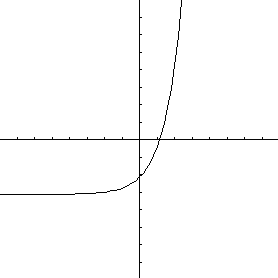

If there's one thing we've learned from the internet...it's this: distributed systems work. In any sort of goods or services production, we're always trying to achieve economies of scale--ever since Henry Ford taught us that lesson. But economies of scale can blaze a trail of destruction in their wake, because they have such massive levels of inputs (often natural resources) and outputs (what is produced PLUS whatever the waste product may be). Distributed systems have small point inputs and outputs of whatever they're producing-distributing-using, and aren't as destructive. I'm speaking in the most general terms possible here--it doesn't matter what the distributed system is "carrying".
Back to our example. The internet, and similarly P2P networks, rely on small scale, interconnected, redundant "pieces" to achieve their power. We should have learned by now that the network, not the central plant, is the key to our future. Actually, I believe we have already learned this lesson (nature of course taught us first), but there is much in this world that is highly dependent on the old ways of thinking, and fearful of losing economies of scale (because what would we do then?), so it will take a long time for things to change.
A Slight Misperception
I love my (less than) 15-minute walk to and from work. There is one thing, however, that I don't like about it: You see, I walk through an area of downtown Cleveland called "The Flats". This is the traditional industrial area of Cleveland down by the winding Cuyahoga River; giant freighters pass through there four or five times a day, navigating their way through the difficult passage. This is all very cool. But, being the gradually gentrifying area that it is, it contains a number of low-cost surface parking lots. People park at these and then walk up the hill to downtown. If you park in the flats, you're known for "getting a good deal" so to speak (i.e., being cheap). What I don't like about my walk is that people think I'm just another Flats-parker walking back from my office downtown, heading to my car for a journey back to the suburbs. Hey, I don't PARK in the Flats, I LIVE there! Oh, well, I guess after all I'm just one of those shallow people worried about my image, aren't I?
Using POPFILE to filter my email (which appears to be 98.6% accurate after about 1-1/2 months of training), I’ve learned that 81.8% of my messages are spam, and a mere 18.2% are legit. Ugh.
We and our human contemporaries have a strong tendency to immerse ourselves in self-created environments. The dominance of the media in the home, for better and for worse, and which attests to this, is readily apparent to most of us.
So my opening statement probably comes as no surprise to most people. What surprises me, however, is how immersed in our own environments we can be even when we're in the public realm. I suppose the consumer item that in a sense started all of this was the Sony Walkman, in the 1970s. Think about it, for the first time ever, one had the ability to control the emotional context of one's own sphere. You no longer were subject to the chaotic whims of surrounding background noise and interruptions.
Today, the situation I'm describing is even more pronounced, because we have even more ways to enclose ourselves while in public. We still have music, of course, but also mobile phones, all sizes of computers, and well, I guess we also still have all the traditional media--books, newspapers, etc. I'm enclosing myself in public as I write this, in fact.
I can't help but think of William Gibson's mental environments when I think of how many ways there are to isolate ourselves while around others. It's like "jacking-in" to another world.
But then I think, are we really isolating ourselves? Perhaps it's just another way, maybe even a BETTER way, of connecting to others, and to the world around us. Connection by choice, not just by propinquity. Perhaps both are good, as long as a balance is maintained. We are still physical beings, after all.
Subscribe to:
Posts (Atom)