 Scraping vs. ‘Plunking’
Having finally come to a point in my life where I feel that I have control (and am relatively happy with the state of) my finances, some useful monetary analogies have grown up within my head. One of these is as follows:
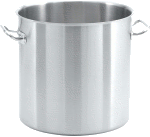
Imagine a big soup pot. This is your potential net worth. Now picture a steady but slow stream (or drip drip drip, if you prefer) of thick, translucent red liquid pouring into the container from above. This is money--your income. To pay your expenses, you must dip a ladle down into the container and take some of the liquid out. If you have a net worth close to zero, you can imagine the sound of the ladle scraping bottom as you try to scoop up enough to pay for this month’s expenses. If you have a larger net worth, you can imagine the nice ‘plunk’ sound as the ladle goes deep into the plentiful liquid to easily pull out as much as is necessary.
There are many little images you can create from this analogy:
- If you don’t have a budget, your soup pot has holes in the bottom of it
- If you are deep in debt, you don’t even have a soup pot (you’re filling someone else’s)
- If you avoid using the liquid faster than it drips in, soon you’ll have a nice deep pool
- Find ways to make the liquid flow into the pot faster
- From time to time, someone suddenly pours in a cup full (these are windfalls)
- As your soup pot fills up, you are entitled to larger and larger pots (and consequently a larger ladle--the reward for your patience and discipline)
I have always maintained a slight sense of internal pride regarding my attitude toward learning from others. Generally, over the course of my life, I have operated under the assumption that people whom are (a) significantly older than me, (b) experts in their field, or (c) more experienced than me should be given the benefit of the doubt that they know what they are doing. A logical consequence of this thinking is that I should attempt to learn from the way these individuals practice their chosen discipline.
Looking back over the various periods of failure, success and mediocrity in my life, I have come to realize that some of my most interesting accomplishments have come when I, at least temporarily, have backhanded this logic across the jaw ignored the best advice of my mentors. Of course, after a brief knockdown, the logic stands to its feet again and continues its influence.
The important thing to remember here is that these temporary interjections of rebellion are surrounded by longer periods of learning and quiet observation. The opportunity to break away from the established practices of mentors and do something (potentially) great is most ripe when you have gleaned from them much of what they have to offer.
Looking back over the various periods of failure, success and mediocrity in my life, I have come to realize that some of my most interesting accomplishments have come when I, at least temporarily, have backhanded this logic across the jaw ignored the best advice of my mentors. Of course, after a brief knockdown, the logic stands to its feet again and continues its influence.
The important thing to remember here is that these temporary interjections of rebellion are surrounded by longer periods of learning and quiet observation. The opportunity to break away from the established practices of mentors and do something (potentially) great is most ripe when you have gleaned from them much of what they have to offer.
A few months ago on a flight back to CLE from LAS, I was observing the land formations, the dry stream beds, the jutting of the rock in the desert, the occasional human intervention in the form of a farm stead or small town. I thought, 'these patterns are a part of me; I understand the natural way that things form.' I remember telling my wife about it at the time.
I continued the strain of thought to further articulate something I've always known, but do not acknowledge much (or enough), and something which forcibly rears its head into my consciousness from time to time:
There are strong analogs in the behavior of almost everything that exists. Nature behaves the way human economies do; traffic behaves the way water flows; social structures mimic various biological patterns; etc. There are nearly infinite examples.
I am a simple but happy person, and have been blessed with a wonderful life thus far. However, if there's one thing I can say that I'm honestly a bit disappointed about, it's that I've not even begun to effectively exploit this intuitive understanding.
I continued the strain of thought to further articulate something I've always known, but do not acknowledge much (or enough), and something which forcibly rears its head into my consciousness from time to time:
There are strong analogs in the behavior of almost everything that exists. Nature behaves the way human economies do; traffic behaves the way water flows; social structures mimic various biological patterns; etc. There are nearly infinite examples.
I am a simple but happy person, and have been blessed with a wonderful life thus far. However, if there's one thing I can say that I'm honestly a bit disappointed about, it's that I've not even begun to effectively exploit this intuitive understanding.
The business world is to a noticeable degree self-reinforcing and has a tendency to be incestuous. On one hand, this can be a positive thing: profitable relationships are strengthened. However, it can also be dangerous. Paths become well worn which benefit individuals but act to the detriment of the sector, or the economy, as a whole. You scratch my back, I scratch yours. We fight each other, but we do not wish to conclusively win, because winning would mean and end to the war, and to our earnings, and thus we must ensure that the environment continues to foster the conflict.

On the train this morning, browsing through Google Reader headlines on my phone, I came across a post on ask.metafilter.com, and it riled me up so much I simply had to respond. Here is the original post:
I want to have value past my mundane existence: ... "Most people can't think, most of the remainder won't think, the small fraction who do think mostly can't do it very well. The extremely tiny fraction who think regularly, accurately, creatively, and without self-delusion – in the long run, these are the only people who count." How do I become one of those people who count?
And here is my response:
The original quote is unbelievably arrogant, and full of conclusions that are difficult, if not impossible to support. How does the person quoted have *any* concept of how many individuals think, let alone the quality of their thinking? And then to make a sweeping value judgment: "...these are the only people that count." Unconscionable.
I'm surprised that so many people in this thread have allowed themselves to be intellectually sucker-punched into thinking that the original quote had any merit whatsoever. And I suspect that the more 'thinking' you do, the more you'll realize that 'being one of those people who count' really doesn't matter that much in this great cyclical organic existence of ours.
I want to have value past my mundane existence: ... "Most people can't think, most of the remainder won't think, the small fraction who do think mostly can't do it very well. The extremely tiny fraction who think regularly, accurately, creatively, and without self-delusion – in the long run, these are the only people who count." How do I become one of those people who count?
And here is my response:
The original quote is unbelievably arrogant, and full of conclusions that are difficult, if not impossible to support. How does the person quoted have *any* concept of how many individuals think, let alone the quality of their thinking? And then to make a sweeping value judgment: "...these are the only people that count." Unconscionable.
I'm surprised that so many people in this thread have allowed themselves to be intellectually sucker-punched into thinking that the original quote had any merit whatsoever. And I suspect that the more 'thinking' you do, the more you'll realize that 'being one of those people who count' really doesn't matter that much in this great cyclical organic existence of ours.
Yesterday, while building wooden train track #10,768 with Max on our living room rug, the little guy surprised me by counting to 33 in odd numbers: 1, 3, 5, 7, 9, etc. I didn't even know he could do that! By around 3-1/2, and in the months approaching 4, Max was able to count to 100 and beyond, to 1,000 by hundreds, do addition and subtraction in his head up to around 12, hand-write several words (including his name of course), type even more words, phonetically read many short and medium length words, and sight read a larger list of words. He can finish the candy level of We Love Katamari by himself, he's a force to be reckoned with on the tricycle, he loves to romp, loves silly dance contests, and has been known to break into an impromptu chorus of 'I've Been Working On The Railroad' at any given moment. I look at the kid and constantly think: It must be a lot of fun to be Max.
Esmé is blossoming. In the past two months as she approaches one year old, her personality has really started to come out. She loves to be pushed around the neighborhood in her little plastic car (clapping enthusiastically as she goes), and she gives Max a run for his money in silly dance contests. She is so beautiful it's distracting...big eyes, curly hair (lots of it), enormous smile (it seems to have grown in the past month). She waves at nearly everything and everybody, with her delicate little fingertip-model-wave. Loves her big brother, loves to chase him and be chased by him; she crawls so quickly she looks like a little beetle scurrying. She's so sweet we call her Zen baby--she's not the intense micro-manager Max that is. She's sweet, that is, until you take away that toy she was playing with...
Esmé is blossoming. In the past two months as she approaches one year old, her personality has really started to come out. She loves to be pushed around the neighborhood in her little plastic car (clapping enthusiastically as she goes), and she gives Max a run for his money in silly dance contests. She is so beautiful it's distracting...big eyes, curly hair (lots of it), enormous smile (it seems to have grown in the past month). She waves at nearly everything and everybody, with her delicate little fingertip-model-wave. Loves her big brother, loves to chase him and be chased by him; she crawls so quickly she looks like a little beetle scurrying. She's so sweet we call her Zen baby--she's not the intense micro-manager Max that is. She's sweet, that is, until you take away that toy she was playing with...
Recently, nearly two years after originally beginning play, and just shortly after the level cap was raised to 70 with the expansion, I reached level 60 in World of Warcraft. The real news here is that, as cheap as I am, someone figured out how to get me to pay $14.99 per month for something that I only play once or twice per week, at most...
Last night on the way home from Rose’s birthday dinner, and from visiting my new nephew (quite a full day), Esmé was sleeping, Max was looking out the window at the lights along the highway, and Rose and I were holding hands enjoying the peaceful drive.
About halfway home, we heard Max in the back seat talking to himself: “Eighty-one, eighty-two, eighty-three…eighty-eight, eighty-nine…Beedy.”
Eh?
He continued: “Beedy-one, beedy-two, beedy-three…beedy-eight, beedy-nine…Seedy.”
Huh?
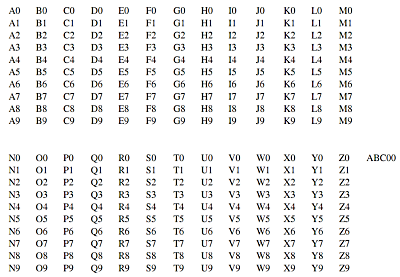
It took us a few minutes, but we figured it out. He was counting by tens using the alphabet as a base: A0 (“A”-dee, not “eighty”), A1, A2, A3, A4, A5, A6, A7, A8, A9, B0 (pronounced “BEE-dee”), B1 (“Beedee-one”), B2, B3… C0, C1, C2, C3, etc. He counted all the way from A0 to Z9 (“Zeedee-nine”), and then proclaimed, “I counted to alphabet-hundred!”
My inventive young man had actually counted to 261, in his own special way. Rose and I were absolutely cracking up the whole time he was doing this (once we realized what was going on, that is). Ah, the mind of a three-year old.
About halfway home, we heard Max in the back seat talking to himself: “Eighty-one, eighty-two, eighty-three…eighty-eight, eighty-nine…Beedy.”
Eh?
He continued: “Beedy-one, beedy-two, beedy-three…beedy-eight, beedy-nine…Seedy.”
Huh?
It took us a few minutes, but we figured it out. He was counting by tens using the alphabet as a base: A0 (“A”-dee, not “eighty”), A1, A2, A3, A4, A5, A6, A7, A8, A9, B0 (pronounced “BEE-dee”), B1 (“Beedee-one”), B2, B3… C0, C1, C2, C3, etc. He counted all the way from A0 to Z9 (“Zeedee-nine”), and then proclaimed, “I counted to alphabet-hundred!”
My inventive young man had actually counted to 261, in his own special way. Rose and I were absolutely cracking up the whole time he was doing this (once we realized what was going on, that is). Ah, the mind of a three-year old.
Now here’s what I call a good weekend: After taking Max to a friend’s fourth birthday party on Saturday morning, Rose and I decided to drive the kids around the perimeter of the Ravenna Arsenal, just to see how creepy and weird it is to have 20,000+ acres of semi-contaminated land fenced off in the middle of otherwise ordinary Ohio. I guess they used to make TNT and other munitions there, primarily during WWII. To put it in perspective, the Arsenal covers more land area than the nearby city of Akron (population: 210,000+). Afterwards, heavy fried food at a local pub.
Over the past few years I've come to realize what perhaps may be my Achilles heel: I have the ability to maintain composure and think clearly in situations of duress and high responsibility, but small annoyances can provide an extreme distraction to me and in fact have the potential to render me near-useless.
An innocuous example: Stressful situation at work; suddenly something has come up; impossible deadline; how can we possibly get this thing done on time? No problem; let me handle it; I'll get it done with five minutes to spare; and I'll likely enjoy myself while doing it.
But if I have a pebble in my shoe or the mobile email feature of my cell phone isn't working all of the sudden, I'll obsess over this “defect in my system” until I can fix it, sometimes at the expense of more important things.
As a corollary to this, and a trait that is I suppose a good one: I love it when things work well; systems, tools, any sort of operation, and I'm pretty good at making things work well when I put my mind to it.
An innocuous example: Stressful situation at work; suddenly something has come up; impossible deadline; how can we possibly get this thing done on time? No problem; let me handle it; I'll get it done with five minutes to spare; and I'll likely enjoy myself while doing it.
But if I have a pebble in my shoe or the mobile email feature of my cell phone isn't working all of the sudden, I'll obsess over this “defect in my system” until I can fix it, sometimes at the expense of more important things.
As a corollary to this, and a trait that is I suppose a good one: I love it when things work well; systems, tools, any sort of operation, and I'm pretty good at making things work well when I put my mind to it.
I suppose I believe something like this:
(1) Go for your dreams, because we're all dead after our sub-100 year stint on this planet. May as well make the most of it.
(2) But be practical while you're doing it, so you'll be able to sleep at night (and hopefully able to avoid living like a pauper in old age).
(3) At the same time, enjoy every moment, because you may be dead tomorrow.
(1) Go for your dreams, because we're all dead after our sub-100 year stint on this planet. May as well make the most of it.
(2) But be practical while you're doing it, so you'll be able to sleep at night (and hopefully able to avoid living like a pauper in old age).
(3) At the same time, enjoy every moment, because you may be dead tomorrow.
Two weeks ago, Max deleted my save-game data for Shadow of the Colossus. I was making an espresso in the kitchen when I heard Rose gasp.
He’s three-and-a-half, and up until now his ability to navigate the PS2 menu system and control CDs/DVDs has been nothing but cute, if not mildly impressive for someone his age. Wake up call! The kid is suddenly able to do technological damage. Time to password protect the computer to prevent the inevitable "format c:" attempt, which at this rate cannot be more than 6-8 months away...
He’s three-and-a-half, and up until now his ability to navigate the PS2 menu system and control CDs/DVDs has been nothing but cute, if not mildly impressive for someone his age. Wake up call! The kid is suddenly able to do technological damage. Time to password protect the computer to prevent the inevitable "format c:" attempt, which at this rate cannot be more than 6-8 months away...
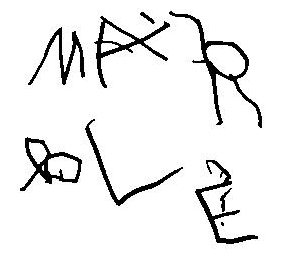
Max (now 3 years, 7 months) wrote 'MARBLE' while writing George Rhodes a thank-you letter!
The rest of the story: Sometime around April 2006, while at Rainbow Babies & Children's Hospital visiting the newborn daughter of friends, Max discovered the work of George Rhoads. The sculpture on display there, 'Circus of the Spheres' (as we now know it), captivated Max's attention for about 45 minutes. We couldn't get the kid outta there.
About three months later, shortly after Esmé's birth, our DVR grabbed an older Mister Rogers episode featuring George Rhoads. Needless to say, that episode has been marked 'do not erase'. Max had suddenly developed a rapidly growing interest in 'ball machines', marbles, and all things related (probably the earliest manifestation of this interest was Max's fascination with the Animusic video 'Pipe Dream'). Multiple web searches ensued.
Next we discover that George Rhoads lives in Ithaca, our stomping grounds for 3+ years (and we didn't have a clue)! Rose quickly acquires the studio telephone number, makes a call, and presto, Max has a private tour of Mr. George Rhoads' studio scheduled, which serendipitously coincided with my attending the annual Cornell Real Estate Conference. What a wonderful time that was; Max just drank it in.
For Christmas 2006, Santa brought Max a Quercetti marble run (with auto-collecting marble-return elevator, thank-you), and the marble madness continues when he and I play video games like Ballance together.
Are marbles the new trains?
Movin' On Up.
Well, the Carroll-Merendino household is finally due for its regularly-scheduled 5-year computer upgrade. It's fun to look at specs:
Well, the Carroll-Merendino household is finally due for its regularly-scheduled 5-year computer upgrade. It's fun to look at specs:
| Old | New | |||
| Processor | Intel Mobile Pentium 4 M 1.8 GHz | |||
| Memory | 512 MB DDR-266 SDRAM | |||
| Graphics | Mobility Radeon 7500 | |||
| Hard Disk | 60 GB 5,400-RPM | 64 GB Samsung Solid State Boot Drive (added 10/5/11; cost $80) + | ||
| Optical | DVD/CD-RW | |||
| Motherboard | Unknown | Asus P5B-VM | ||
| Networking | 802.11b & Ethernet | 802.11n & Ethernet | ||
| Display | 15" XGA LCD | |||
| Case | Laptop | Thermaltake Lanbox 550W | ||
| OS | XP Home |
A question was posed: Are people happier when they are "time-affluent" or "money-affluent"? My answer:
Ultimately, I believe everything, including happiness, comes from within, but is then influenced (dampened or reinforced) by things external. Related to this, I believe that the life we experience (all the things external) is more or less a result of our internal orientation.
Over time, people bring to themselves what they are.
I believe happiness is most reinforced by positive relationships with other people. Those of us who are fortunate enough to have loved ones close to us (spouse, children, friends, parents, siblings) have an easier time of it.
I also believe that a strong orientation toward internal happiness comes from a childhood full of mostly love, joy and fun. This builds confidence and enables people to stand on their own. I believe the strongest relationships are between people who are comfortable by themselves.
Relating this to work and money: Not having enough money to avoid "living paycheck to paycheck" will cause a lot of stress for anyone--internally happy or not. It's not so bad to work hard for money, even if it takes a lot of time, so long as your priorities remain correctly aligned (i.e., don't neglect yourself, your spouse, your children, your family, your friends). If you find yourself working 80 hours per week at a job you love, so be it. If you feel better working 3 days per week for less money, so be it. Happiness is equally possible in all situations. Again, it is not a product of your situation, it is only influenced by it.
A final thought* -- If you are not happy, in all likelihood it is largely because you are not living up to the internal expectations you have set for yourself.
(*Not in original post. Original post here.)
Ultimately, I believe everything, including happiness, comes from within, but is then influenced (dampened or reinforced) by things external. Related to this, I believe that the life we experience (all the things external) is more or less a result of our internal orientation.
Over time, people bring to themselves what they are.
I believe happiness is most reinforced by positive relationships with other people. Those of us who are fortunate enough to have loved ones close to us (spouse, children, friends, parents, siblings) have an easier time of it.
I also believe that a strong orientation toward internal happiness comes from a childhood full of mostly love, joy and fun. This builds confidence and enables people to stand on their own. I believe the strongest relationships are between people who are comfortable by themselves.
Relating this to work and money: Not having enough money to avoid "living paycheck to paycheck" will cause a lot of stress for anyone--internally happy or not. It's not so bad to work hard for money, even if it takes a lot of time, so long as your priorities remain correctly aligned (i.e., don't neglect yourself, your spouse, your children, your family, your friends). If you find yourself working 80 hours per week at a job you love, so be it. If you feel better working 3 days per week for less money, so be it. Happiness is equally possible in all situations. Again, it is not a product of your situation, it is only influenced by it.
A final thought* -- If you are not happy, in all likelihood it is largely because you are not living up to the internal expectations you have set for yourself.
(*Not in original post. Original post here.)

Time: Messy Is The New Neat.
I think there is some value to this article: If one is obsessed with neatness and organization, then tending to the "system" becomes the only thing that a person gets done. Overly-cumbersome organizational systems can be more harmful than zero organization.
That said, I am a firm believer that it is difficult for anyone to get a lot of simultaneous projects done without some sort of organizational/prioritization system. The key is that the system must be easy to maintain and it must fit your personal work style.
I think there is some value to this article: If one is obsessed with neatness and organization, then tending to the "system" becomes the only thing that a person gets done. Overly-cumbersome organizational systems can be more harmful than zero organization.
That said, I am a firm believer that it is difficult for anyone to get a lot of simultaneous projects done without some sort of organizational/prioritization system. The key is that the system must be easy to maintain and it must fit your personal work style.
In the past I have always had a tradition of sitting down by myself for a few hours on New Year’s Day to think about my goals for the coming year, and to ponder a bit about the year just past.
Over the last few years I have become much better at articulating, tracking and revising my goals, as well as actually getting things done. As I was sitting down this morning, I enjoyed my mental trip back through the past year. However, as I was thinking ahead I realized that I was pretty much already working on most of what I would consider to be this year’s goals.
I suppose I’ve evolved into a believer that the New Year is no time to be coming up with resolutions. It’s so much better to be working on them already. Immensely more mental and spiritual peace comes when goals are treated as “working tools” that get updated, beat up, reviewed, checked-off, completed, canceled, etc., than as some sort of sacred idea that gets placed on a pedestal one time per year.
Over the last few years I have become much better at articulating, tracking and revising my goals, as well as actually getting things done. As I was sitting down this morning, I enjoyed my mental trip back through the past year. However, as I was thinking ahead I realized that I was pretty much already working on most of what I would consider to be this year’s goals.
I suppose I’ve evolved into a believer that the New Year is no time to be coming up with resolutions. It’s so much better to be working on them already. Immensely more mental and spiritual peace comes when goals are treated as “working tools” that get updated, beat up, reviewed, checked-off, completed, canceled, etc., than as some sort of sacred idea that gets placed on a pedestal one time per year.
Microplaces
I am a connoisseur of delightful spots. Not in the graphic sense, like spots on a dog; rather, “microplaces”. Precise locations whose characteristics can be enjoyed in the same manner as fine food, wine, art, music, performance. This type of experience goes beyond a simple appreciation for architecture or urban design. This is the full intellectual-sensory act of sitting-standing-lying in a specific place that is delightful (or horrible, if you prefer) in every capacity and drinking it in--sight, sound, material-tactile, smell, microclimate, human proximity and activity. A few meters variance can change everything. It is the type of experience that cannot be photographed; the written word comes closest, but any description still leaves much lacking.
Ask my wife; she knows that I must find the perfect spot in a restaurant, park, room, etc., and then place myself there (or, inflict my specificities on my whole family if they are accompanying me). Am I difficult to live with? Yes, sometimes. But it’s just another one of the ways that I enjoy life.
For a few minutes, where you place yourself within a place can make all the difference in the world.
I am a connoisseur of delightful spots. Not in the graphic sense, like spots on a dog; rather, “microplaces”. Precise locations whose characteristics can be enjoyed in the same manner as fine food, wine, art, music, performance. This type of experience goes beyond a simple appreciation for architecture or urban design. This is the full intellectual-sensory act of sitting-standing-lying in a specific place that is delightful (or horrible, if you prefer) in every capacity and drinking it in--sight, sound, material-tactile, smell, microclimate, human proximity and activity. A few meters variance can change everything. It is the type of experience that cannot be photographed; the written word comes closest, but any description still leaves much lacking.
Ask my wife; she knows that I must find the perfect spot in a restaurant, park, room, etc., and then place myself there (or, inflict my specificities on my whole family if they are accompanying me). Am I difficult to live with? Yes, sometimes. But it’s just another one of the ways that I enjoy life.
For a few minutes, where you place yourself within a place can make all the difference in the world.
Living in a city that ranks within the bottom quartile for “average sunny days per year”, one of my favorite experiences is breaking through the cloud barrier on a rainy morning only to see the sun shining brightly above the layers. I cannot help but think that if one's hometown gets less than 100 days of sun annually, one's outlook will be somewhat more optimistic if that cloud barrier is broken on a regular basis (ceteris paribus).
(Did you know that Miami, Florida is also in the bottom quartile of the “average sunny days” ranking?)
(Did you know that Miami, Florida is also in the bottom quartile of the “average sunny days” ranking?)

The Dragon-Riding Boy
A few weeks ago at the county fair, among the many other things that caught Max’s eye (including his new interest in the midway carny games) was a kid-sized roller coaster that he referred to as “the dragon train”. It was apparently designed to look like the Loch Ness monster.
After standing there watching it operate for about ten minutes, Max developed what appeared to be an excruciating desire to go on this ride. Rose and I of course said no, but he kept insisting. So against our (really Rose’s) better judgment, we decided to let him do it. The rest of the riders were, by appearance, five- to seven-year olds. Since he was too short to ride by himself, I shoehorned myself into the car with him. He kept telling me to get in the car behind him--he was a big boy and didn’t want me in the same car. In what seemed to be a preview of junior-high-esq behavior, he was really bothered that I was riding with him.
When the half-paying-attention high-school-kid-operator hit the “start” button, the train lurched forward violently and then picked up even more speed as it connected with the spinning drive-tire mounted between the tracks at the first curve. This ride was definitely not for 3-year olds. Max had a minor freak-out.
Rose jumped up onto the platform and yelled at the operator to stop the train, which he did. (Later, someone commented that Rose looked as if she were going to throw herself across the tracks to stop that train...) All the older kids started grumbling because their ride was interrupted, and I quickly started to unlatch the restraints to exit the train.
Max’s eyes were open as far as physically possible, he had a few tears on his red cheeks, his hair was blown back, and he was smiling the uncertain smile-frown of someone who had just, say, bungee-jumped for the first time. “No, Daddy, I don’t want to get off.”
“Are you sure, Max?” I asked as I was holding him close. Rose wasn’t going to have any of this. However, after about twenty-five seconds of silent visual debate between Rose and me, and a couple more queries to Max, we decided to stay on.
As we whipped around that short oval track about ten more times, Max mimicked the older kids, squealing as we went up and down and around the curves. Because of his age (and consequent size), he was buffeted about much more than the older kids. I watched his face as we rode, full of terror, excitement, curiosity, and a few other things I can’t quite identify, other that to say that most of what he was feeling was probably good for him. For the duration of the ride I held him as carefully as he’d let me, sweating, making sure that he didn’t get jolted too hard. The whole thing lasted about one minute, but Max and I felt like we were flying for hours.
He talked about that ride all night, and over the next several days, and I think there’s a chance he’ll always remember it. He would tell us, “That guy stopped the ride, and they asked me if I wanted to get off, and I said, ‘No, I don’t want to get off, because I’m a big boy.’” He was so proud of himself.
Max very is highly responsive to loud noise, sometimes gets scared easily, and tends to be quite cautious. He’s a very sensitive boy, but here’s what else I’ve learned: He’s also very brave. He seems to have a natural inclination to face things that scare him. This, among many other things, makes me very proud of him.
It makes me think, maybe I’m brave too.
A few weeks ago at the county fair, among the many other things that caught Max’s eye (including his new interest in the midway carny games) was a kid-sized roller coaster that he referred to as “the dragon train”. It was apparently designed to look like the Loch Ness monster.
After standing there watching it operate for about ten minutes, Max developed what appeared to be an excruciating desire to go on this ride. Rose and I of course said no, but he kept insisting. So against our (really Rose’s) better judgment, we decided to let him do it. The rest of the riders were, by appearance, five- to seven-year olds. Since he was too short to ride by himself, I shoehorned myself into the car with him. He kept telling me to get in the car behind him--he was a big boy and didn’t want me in the same car. In what seemed to be a preview of junior-high-esq behavior, he was really bothered that I was riding with him.
When the half-paying-attention high-school-kid-operator hit the “start” button, the train lurched forward violently and then picked up even more speed as it connected with the spinning drive-tire mounted between the tracks at the first curve. This ride was definitely not for 3-year olds. Max had a minor freak-out.
Rose jumped up onto the platform and yelled at the operator to stop the train, which he did. (Later, someone commented that Rose looked as if she were going to throw herself across the tracks to stop that train...) All the older kids started grumbling because their ride was interrupted, and I quickly started to unlatch the restraints to exit the train.
Max’s eyes were open as far as physically possible, he had a few tears on his red cheeks, his hair was blown back, and he was smiling the uncertain smile-frown of someone who had just, say, bungee-jumped for the first time. “No, Daddy, I don’t want to get off.”
“Are you sure, Max?” I asked as I was holding him close. Rose wasn’t going to have any of this. However, after about twenty-five seconds of silent visual debate between Rose and me, and a couple more queries to Max, we decided to stay on.
As we whipped around that short oval track about ten more times, Max mimicked the older kids, squealing as we went up and down and around the curves. Because of his age (and consequent size), he was buffeted about much more than the older kids. I watched his face as we rode, full of terror, excitement, curiosity, and a few other things I can’t quite identify, other that to say that most of what he was feeling was probably good for him. For the duration of the ride I held him as carefully as he’d let me, sweating, making sure that he didn’t get jolted too hard. The whole thing lasted about one minute, but Max and I felt like we were flying for hours.
He talked about that ride all night, and over the next several days, and I think there’s a chance he’ll always remember it. He would tell us, “That guy stopped the ride, and they asked me if I wanted to get off, and I said, ‘No, I don’t want to get off, because I’m a big boy.’” He was so proud of himself.
Max very is highly responsive to loud noise, sometimes gets scared easily, and tends to be quite cautious. He’s a very sensitive boy, but here’s what else I’ve learned: He’s also very brave. He seems to have a natural inclination to face things that scare him. This, among many other things, makes me very proud of him.
It makes me think, maybe I’m brave too.
Warning--fatherly bragging ahead: Last night, Max counted to 100 with almost no help! Not bad for 3.17-year old!
Two nights ago, Max started to tell me something about his trains. He began by saying, "You know daddy, the funny thing about these trains is..."
It's hilarious to hear such adult-sounding things coming out of such a little person.
Two nights ago, Max started to tell me something about his trains. He began by saying, "You know daddy, the funny thing about these trains is..."
It's hilarious to hear such adult-sounding things coming out of such a little person.
On ask.metafilter.com, a user asks: "In the U.S., why does a family need two incomes to live at a standard that was previously attainable by one?" Here is my answer.

Hamlet, Act 3, Scene 3, KING CLAUDIUS:
"My stronger guilt defeats my strong intent;
And, like a man to double business bound,
I stand in pause where I shall first begin,
And both neglect. ..."
For some reason this has stayed with me since the first time I read Hamlet in high school. It's taken out of context here, but on it's own this quote has always reminded me to avoid the trap of worrying so much about stuff that I just sit there and worry more (and do nothing about my situation). In other words: take action.
(Original Lifehacker post here.)
"My stronger guilt defeats my strong intent;
And, like a man to double business bound,
I stand in pause where I shall first begin,
And both neglect. ..."
For some reason this has stayed with me since the first time I read Hamlet in high school. It's taken out of context here, but on it's own this quote has always reminded me to avoid the trap of worrying so much about stuff that I just sit there and worry more (and do nothing about my situation). In other words: take action.
(Original Lifehacker post here.)
On Lifehacker, a question: "What's easier when you're young?"
My answer: Seems like this question is more about "life committments" than age. Other than the limitations of our physical bodies that seem to increase with age, life's primary constraint becomes available time. Someone who's 20, 30 or 40 with no kids, spouse, mortgage, etc. is likely to have an equivalent ability to do anything they want--in fact the older individual in this example would be better able to do "anything" due to their assumed superior financial situation, ceteris paribus.
There seems to be a strong correlation between getting older and committments to things other than the self (kids, spouse, jobs, etc.). And so we create our own framework that becomes difficult to break from without careful planning.
As for me, at 33, everything in life seems easier, not harder, than when I was 13, 18, 23, even 28. I feel more confident that I've ever been, more sure about "the way the world works", etc. The only challenge is finding the time to do all the great things there are to do out there, because I have a wife and two kids. However, as I've learned, many of the best, sweetest things in life involve those very people that "take" so much of my time. So, yes, it's more difficult to do the 2-month road trip around the country (which I did with a buddy when I was 23), but I don't really care because I'm enjoying everything else so much.
The old cliche is, "If I only knew then what I know now..." Funny how true it is. A 23-year old who's wise enough to truly listen to the advice of a 33, 43, 53, 63, 73, 83, 93-year old will certainly get a jump on getting the most out of this rich life.
My answer: Seems like this question is more about "life committments" than age. Other than the limitations of our physical bodies that seem to increase with age, life's primary constraint becomes available time. Someone who's 20, 30 or 40 with no kids, spouse, mortgage, etc. is likely to have an equivalent ability to do anything they want--in fact the older individual in this example would be better able to do "anything" due to their assumed superior financial situation, ceteris paribus.
There seems to be a strong correlation between getting older and committments to things other than the self (kids, spouse, jobs, etc.). And so we create our own framework that becomes difficult to break from without careful planning.
As for me, at 33, everything in life seems easier, not harder, than when I was 13, 18, 23, even 28. I feel more confident that I've ever been, more sure about "the way the world works", etc. The only challenge is finding the time to do all the great things there are to do out there, because I have a wife and two kids. However, as I've learned, many of the best, sweetest things in life involve those very people that "take" so much of my time. So, yes, it's more difficult to do the 2-month road trip around the country (which I did with a buddy when I was 23), but I don't really care because I'm enjoying everything else so much.
The old cliche is, "If I only knew then what I know now..." Funny how true it is. A 23-year old who's wise enough to truly listen to the advice of a 33, 43, 53, 63, 73, 83, 93-year old will certainly get a jump on getting the most out of this rich life.
Esmé Rose Carroll came into the world Wednesday, June 21 at 8:54 AM, 28 minutes after the 2006 summer solstice, which occurred at 8:26 AM the same morning.

I thoroughly enjoyed Jaron Lanier’s essay at Edge.org critiquing the notion of a collective or new consciousness arising on the earth via the internet. While I personally believe that over time information technology will connect humanity in such a way that a new or collective consciousness could be possible, Lanier’s essay provides an important intellectual pause. Let’s not get too infatuated with these ideas before the time is right. From the introduction:
The hive mind is for the most part stupid and boring. Why pay attention to it?
The problem is in the way the Wikipedia has come to be regarded and used; how it's been elevated to such importance so quickly. And that is part of the larger pattern of the appeal of a new online collectivism that is nothing less than a resurgence of the idea that the collective is all-wise, that it is desirable to have influence concentrated in a bottleneck that can channel the collective with the most verity and force. This is different from representative democracy, or meritocracy. This idea has had dreadful consequences when thrust upon us from the extreme Right or the extreme Left in various historical periods. The fact that it's now being re-introduced today by prominent technologists and futurists, people who in many cases I know and like, doesn't make it any less dangerous.
DIGITAL MAOISM: The Hazards of the New Online Collectivism, by Jaron Lanier (via BoingBoing). The responses to the essay are also very much worth reading.
The hive mind is for the most part stupid and boring. Why pay attention to it?
The problem is in the way the Wikipedia has come to be regarded and used; how it's been elevated to such importance so quickly. And that is part of the larger pattern of the appeal of a new online collectivism that is nothing less than a resurgence of the idea that the collective is all-wise, that it is desirable to have influence concentrated in a bottleneck that can channel the collective with the most verity and force. This is different from representative democracy, or meritocracy. This idea has had dreadful consequences when thrust upon us from the extreme Right or the extreme Left in various historical periods. The fact that it's now being re-introduced today by prominent technologists and futurists, people who in many cases I know and like, doesn't make it any less dangerous.
DIGITAL MAOISM: The Hazards of the New Online Collectivism, by Jaron Lanier (via BoingBoing). The responses to the essay are also very much worth reading.
While putting cream into my before-work coffee one morning several weeks ago, I noticed an old woman next to me. She was well into her late eighties by my estimation, hunchbacked, moving pretty slowly. I thought to myself, “Enjoy that coffee; who knows how many you have left?” And that thought had no negativity whatsoever--it was simply a recongntion of a given state of being.
Indeed, observing the woman, she certainly did seem to be enjoying the moment, as much as any human could possibly enjoy anything. She was fully into that coffee like nothing else existed, sipping slowly, smelling it as she drank.
Much to learn from this.
Indeed, observing the woman, she certainly did seem to be enjoying the moment, as much as any human could possibly enjoy anything. She was fully into that coffee like nothing else existed, sipping slowly, smelling it as she drank.
Much to learn from this.
Wow, this guy is trying to do the same thing as me. Except he's given himself 20 years to do it (I'm shooting for 10). And he's way ahead of me. And he's a couple years younger than me. And he's single with no kids. Sheesh...guess I have my work cut out for me.
Great website, though!
Great website, though!
On Lifehacker: Understanding camera basics: '...one has not experienced the 'true joy' of photography until one has adjusted the aperture dial based on depth of field desired and light available, gently twisted the focus ring, then clicked the shutter release to hear that beautiful, hollow, mechanical sound of the mirror and shutter moving out of the way so light can reach the exposure plate at the back of the camera. It's kinda like that first drink of coffee in the morning, or clearing all the dots on a level of Pac-Man, or when the lawnmower starts perfectly on the first pull, or when you land the bat right smack in line with the centroid of the ball...you get the point.'
Comments at Lifehacker: Airport security tips; The pitfalls of nagging / Dealing with delicate situations.
I love Pandora. Listen to my station, LemonHooverKraft. It's built on Lemon Jelly, Kraftwerk, Hooverphonic and Portishead, with a lot of custom selection of songs.
The Future Is Free (haven't we heard that before?)
A few months ago my hard drive crashed and I was forced to do a clean install of Windows XP. Thankfully I was able to save all my data. I used the crash as an opportunity to revisit my software choices. The result of this is that, excluding the operating system and a few games, I now have only three “non-free” applications installed on my computer: Outlook (personal information management & email; I'd probably use a different program if I didn't sync with a PocketPC smartphone), Quicken (personal finance), and Pinnacle Studio (video editing). These are the only three applications for which I could find no suitable free/open-source replacement. Here are a few of the notable programs installed on my system:
- Firefox - replaces Internet Explorer
- OpenOffice.org - replaces Microsoft Office
- GIMP - replaces Photoshop
- Ad-Aware, Spybot S&D, ZoneAlarm - security, cleaning & firewall
- Computer Associates EZAntiVirus - anti-virus
- iTunes - music player (syncs with iPod; if I didn't have an iPod I'd likely use WinAmp)
- Others worth mentioning: WS FTP LE; CCleaner; TMPGEnc; Trillian; uTorrent; MultiMon Taskbar; ObjectDock; Yahoo! Go for TV; Google Desktop; MAME...
Subscribe to:
Posts (Atom)