Recency: The most recent events dominate those in the less recent past, which are downgraded or ignored.
Anchoring: Predictions of the future are unduly influenced by initial information, which is given more weight than it deserves.
Illusory correlations: Belief that patterns are evident and/or that two variables are causally related when they are not.
Optimism, wishful thinking: People’s preferences for future outcomes affect their predictions of such outcomes.
Underestimating uncertainty: Excessive optimism, illusory correlation, and the need to reduce anxiety result in underestimating the uncertainty of future events.
Adapted from Spyros G. Makridakis, “Forecasting, Planning, and Strategy for the 21st Century,” 1990.
- The current economic slowdown, which could last up to three years, will likely do wonders to keep attractive older, lower-income, inner-city neighborhoods from becoming yuppie-havens. It's a simple cash flow issue.
- I think I have a truly feasible idea to help solve the gentrification problem in many American cities. It probably won't work in NYC because of historic rent control issues, but it should work most metropolitan areas whose economies have not been skewed by ubiquitous rent control. The idea has to do with home equity refinancing, the condominium ownership structure, and community-based education of basic financial concepts.
Futurism was a wide-ranging Italian movement that included painting, graphics, sculpture, poetry, literature and the performing arts and focused on the dynamic, energetic and violent character of changing 20th century life. It especially emphasised the power, force and motion of machinery combined with the contemporary fascination with speed. On the downside it also glorified war, denigrated women, favoured Fascism and vilified artistic tradition wanting to "…destroy the museums, libraries, academies of every kind…".
So, yes, the movement had its problems. But it sure did result in some fascinating building designs...
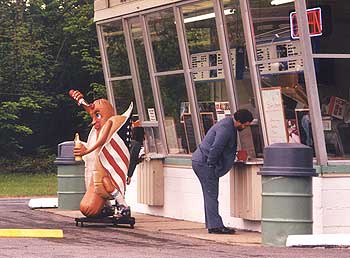
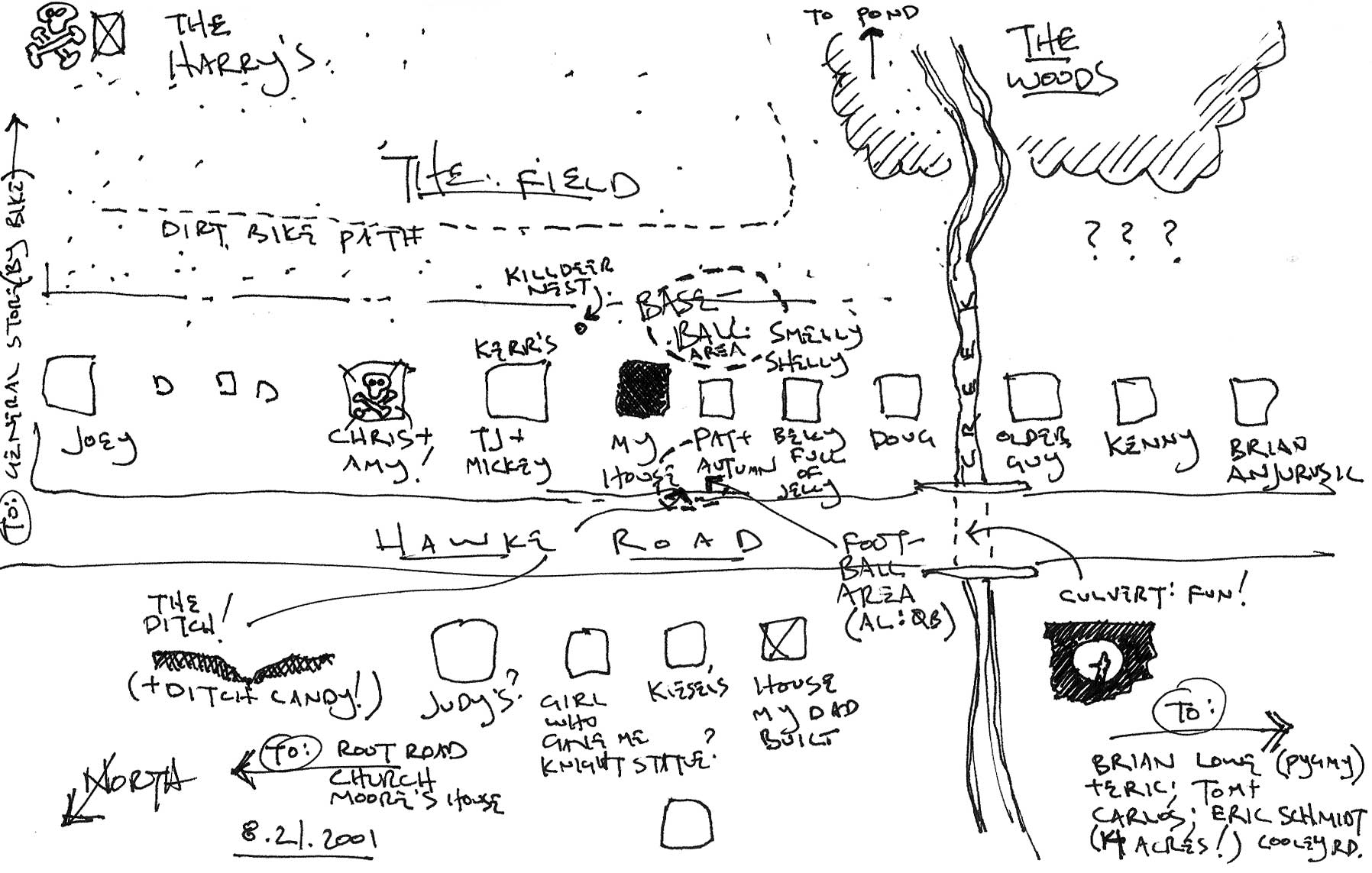
So now I’m back in Ithaca, trying to rest before the hurricane that is Cornell graduate school begins, and I get this bad news. This makes me very, very sad. The Arabica Coffeehouse at Coventry played an important role in my life, just like many people in this story. And how sadly typical—there’s a chance that it’s going to be replaced by a Starbucks. Now, the funky-cool, restless high school kids hanging outside will probably be replaced by the khakis and SUV set. Homogenization. Good for milk, not for culture.
Public declaration to my wife Rose: If I ever become that kind of real estate developer or property owner, please lock me securely in a small metal box, only providing a small meal of moldy bread and water each day.


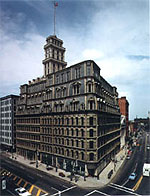 I told you that I’d tell you what I was working on. This is the Powers Building in Rochester, New York. It’s located downtown right at the intersection of, what else, State and Main Street. It was built by a man named Daniel Powers in 1890, and at the time it was the tallest building in the United States west of New York City. It was the first building in the city to have a passenger elevator (which cost $0.05 to ride to the top), and also housed the first art gallery in Rochester.
Now, Mr. Powers had quite an ego. As high-rises in Chicago and Cleveland surpassed the Powers block in height, he would add a story to the building. This occurred three times over the years, giving the building the “wedding cake” effect you see in the upper mansards. Alas, the Powers Block couldn’t compete with newer structural technology, and even with the tower on top, the building was eventually bested by more modern high-rises.
The sequential additions over the years had an interesting effect on the building. Fact: there are nine fully functioning floors in the Powers Building. Now look at the exterior photograph—how many do you see? I’ll give you a hint—what was so special about the office building in the film Being John Malkovich?
For a long time I’ve felt just a little bit guilty about the fact that I criticize people who only like representational art. Usually, these people judge the quality of artwork by how realistically it depicts its subject matter. I’ve also traditionally been very critical of people who value highly sentimental artwork, much of which is popular in mainstream and commercial art venues. The reason I’ve felt guilty is because I’ve thought to myself, “Who am I to judge what someone else prefers?”
I’m tired of apologizing for being judgmental and didactic. No more—I think it’s just fine to be that way. I mean, if you never make any firm value judgments, how do you even know who you are?
This past weekend, Rose, some friends and I visited a very interesting gallery that was assembled inside an old sawmill. Unfortunately, the architecture of the gallery was where the interest ended—every piece of work inside was a detailed rendering of a landscape, a portrait of someone, an automobile, or a street scene. All of the work was fairly well executed, but where was the soul?
Purely representational artwork is often nothing more than an artist showing off—it is a display of technical expertise—it is illustration. I like abstract work better—wait, let me rephrase that—abstract work is better—because it allows for the viewer’s own interpretation of the meaning of the work. It allows, and encourages, the viewer to think. When I look at a portrait or a landscape I think, “Oh, there’s a portrait [or a landscape]. I like the colors. Neat.” And that’s it—end of brain use. When artwork is simply pretty it is not art—it’s craft. Craft has a place, but don’t call it art.
To summarize: Abstract artwork is better than perfectly representational craft. Representational craft pieces can sometimes be redeemed (and actually called art) if they have an interesting narrative or extraordinarily unique style. If you disagree with me, you are wrong, and how do you like that [tongue stuck out]?
Alright…so I’ve learned that everything is a big gray soup (or should I say a wonderful rainbow-colored soup)—that everything relates to everything else…all of the natural world…all matter, energy, thoughts, actions, reactions, etc. are interconnected. Fine. That’s understood.
I’ve also learned that human behavior, and the institutions by which we choose (or not?) to relate ourselves to the world, in the long run, behave as the rest of nature does—by principles of organized chaos (for example the way a tree grows or the way a canyon forms). Cultures, families, economics, trade, finance, mathematics, religion, traffic, technology, etc.
I’ve also learned that there is a manner of existing in the world—of living, of doing business, of creating, of surviving, of sustaining, of nurturing—that reconciles the relationships between the two axioms I just put forth…i.e. the stock market behaves like a river behaves like a traffic jam behaves like salmon swimming upstream behaves like sand dunes behaves like supply and demand behaves like a volcano, etc. Equilibrium (or some would say, entropy) is the ever-elusive goal of all natural systems. And all systems are natural, whether we think they are or not.
I understand all of this. I understand that there is a beautiful ballet that occurs between all of these things. What I do not yet understand is how this stuff will manifest itself in my life. I feel that I am so young and green, that even though I understand all these ideas, I cannot yet utilize them.
Oh, wait, I take that back…there was one big one: it was considered wrong to live in the city. In the late 70s and early 80s, growing up in rural/suburban America, the image of the city was that of a dangerous, sinful place. It was full of crime, traffic, congestion, people of a bad influence, and strangers with candy.
Today, many urban protagonists (such as myself) deride the suburbs as being environmentally and socially irresponsible, dysfunctional (à la American Beauty), exclusive, isolated and out of touch. Yes, many of these concerns are justified. But are we being too critical? Are we, the brave young urban pioneers of Middle America, being just as judgmental as the suburbanites were a decade or two ago?
- From what I’ve heard so far, the latest Hooverphonic album sounds good good good.
- On Route 31F in Rochester, there’s a run-down looking gas station on the south side of the road. This particular run-down gas station also sells live Maine lobster and fine cuts of black angus beef. Interesting.
- Here’s one of the things I hate about myself: I’ll make some sort of simple realization that’s common sense to most people, like “don’t drive in the left lane if there are no left turn lanes on this road,” and treat it like an epiphany, telling everyone I know. Sometimes I think that I’m not the sharpest tack in the box.
Little moments of beauty, I must photograph them all.
You see, once you find something good, you want to capture it and relive it—replay it like a good song. But the whole point of the thing is that you can’t do that because those moments come when they will and you must be open to them, otherwise you will miss them. They come when they will and you can’t make them come and you can’t replay them, only remember them. That’s why a great song doesn’t give you the same feeling every time—in fact it wears out after a while.
Great moments of emotional clarity and awakening only come when you’re not looking, and your mind and heart are open.
This all leads to the point of why nostalgia is so dangerous. People are looking to relive their past precious moments by recreating the past. By doing this, they are closing their minds and their hearts to the present and missing the wonder of the now.
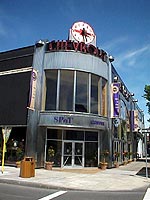 Spot Coffee, here in Rochester, is a very large, well-executed (design, service, quality of food & beverage) coffeehouse. It reminds me of some of the original coffeehouses I visited in Budapest about seven years ago: enormous, elegant, open rooms with a bar in the center, serving a wonderfully diverse group of clientele. Students, professionals, the elite, the poor, the misfits, the gypsies, they were all there. This one’s a bit funkier (and a bit more yuppie-dominated) than those traditional coffeehouses (it’s built inside an old Chevrolet showroom), but it revives the essence.
Six o’clock on a Tuesday evening, and cars are backed up one-quarter of a mile atop the lift bridge crossing the old Erie Canal.
On another note... Have you ever been to a store that’s simply so beautiful and well executed that you wished you had a need for something they sell? The Ithaca Guitar Works is such a store for me. I don’t play guitar, and don’t ever really intend to, but this store is so wonderful that it makes me wish I did.
It really bothers me that I’ll only be able to spend, at most, 10-15% of my life sittin’ around thinking. I think that’s why I’m resentful of any job I’ve held, even it was a great job. (Any past or potential employers reading this can feel free to completely ignore that last sentence.) Thinking for the purposes of commerce just isn’t as fun.
Knowing that he was still alive gave me reassurance that there was yet another person out there that understood the insanity of the world, and wasn’t afraid to unapologetically communicate it. By creating analogies to human life through stories of strange events in outer space, Adams pointed out the silliness that underscores many of the world’s major problems. One of my favorite quotations from his entire body of work lies in the first few pages of Hitchhiker’s Guide:
This planet [referring to the Earth] has—or rather had—a problem, which was this: most of the people living on it were unhappy for pretty much of the time. Many solutions were suggested for this problem, but most of these were largely concerned with the movements of small green pieces of paper, which is odd because on the whole it wasn’t the small green pieces of paper that were unhappy.
Well, that about sums it up for me. Speaking for myself and the rest of the people out there who are often confused by what goes on in this world, we’ll miss you Douglas.