





Left to right: "Sugar Smax" - "Mr. Serious" & "The Look" - "Mr. Turtle"
What's missing: Ol' Popeye (AKA Mr. One-Eye). I'll try to get a photo of that one soon. Boy, oh, boy, it's impossible to get anything done with him around. Ya just wanna stare at him and play with him all day...
Three days later, along the same route (I take different paths to work for variety), before I knew it, my body had involuntarily turned down the same shortcut. There was no conscious effort involved, in fact my mind was heavily occupied with other thoughts. Some sort of coordination between my subconscious mind and my body had occurred, and I was now taking the shortest distance between two points.
It made me think: I'd like to try an experiment. Take an urban area, say a 10-block by 10-block zone, with a lot of irregularities internally, and ask 100 or more people to participate. Then set a "Point A"--the beginning--and a "Point B"--the destination. Set up some barriers in the zone--things that prevent people from taking the obviously shortest route. Then create several hidden shortcuts that are far from obvious.
I'll bet that before 10 minutes elapses, everyone will be taking the shortcuts. The Path of Least Resistance, an irresistible, instinctive force, will govern the situation.
Back to our example. The internet, and similarly P2P networks, rely on small scale, interconnected, redundant "pieces" to achieve their power. We should have learned by now that the network, not the central plant, is the key to our future. Actually, I believe we have already learned this lesson (nature of course taught us first), but there is much in this world that is highly dependent on the old ways of thinking, and fearful of losing economies of scale (because what would we do then?), so it will take a long time for things to change.
I love my (less than) 15-minute walk to and from work. There is one thing, however, that I don't like about it: You see, I walk through an area of downtown Cleveland called "The Flats". This is the traditional industrial area of Cleveland down by the winding Cuyahoga River; giant freighters pass through there four or five times a day, navigating their way through the difficult passage. This is all very cool. But, being the gradually gentrifying area that it is, it contains a number of low-cost surface parking lots. People park at these and then walk up the hill to downtown. If you park in the flats, you're known for "getting a good deal" so to speak (i.e., being cheap). What I don't like about my walk is that people think I'm just another Flats-parker walking back from my office downtown, heading to my car for a journey back to the suburbs. Hey, I don't PARK in the Flats, I LIVE there! Oh, well, I guess after all I'm just one of those shallow people worried about my image, aren't I?
So my opening statement probably comes as no surprise to most people. What surprises me, however, is how immersed in our own environments we can be even when we're in the public realm. I suppose the consumer item that in a sense started all of this was the Sony Walkman, in the 1970s. Think about it, for the first time ever, one had the ability to control the emotional context of one's own sphere. You no longer were subject to the chaotic whims of surrounding background noise and interruptions.
Today, the situation I'm describing is even more pronounced, because we have even more ways to enclose ourselves while in public. We still have music, of course, but also mobile phones, all sizes of computers, and well, I guess we also still have all the traditional media--books, newspapers, etc. I'm enclosing myself in public as I write this, in fact.
I can't help but think of William Gibson's mental environments when I think of how many ways there are to isolate ourselves while around others. It's like "jacking-in" to another world.
But then I think, are we really isolating ourselves? Perhaps it's just another way, maybe even a BETTER way, of connecting to others, and to the world around us. Connection by choice, not just by propinquity. Perhaps both are good, as long as a balance is maintained. We are still physical beings, after all.
Three is a powerful number. It is the structural number—in physics three points of connection are all you need to achieve structural stability. Three is the tie-breaker. One is three. You and me and baby makes three.
The Bottom of the Bowl
The stuff at the bottom of the bowl is the tastiest. The most interesting discussions take place near the end of the meeting, or afterward. You only find the good stuff when you dig--and wait.
Always Stop or Take the Side Road
A roadtrip is worthless unless you make several (preferably unplanned) stops. Side roads are more conducive to random stops than highways. If you're going to take the journey, what fun is it if you only have highways to remember?
Later, I notice the post-WWII form: Housing, housing, housing, housing; housing, housing, housing, housing.
On Friday I had to do a “fly-in, fly-out” to Chicago for work. Everything went smoothly—the day was a bit rushed, but hey, that’s how it goes. I’m just amazed by the fact that I had to stop what I was doing at 4:30 PM and start heading toward O’Hare for my 7 o’clock flight. Then the flight was delayed, putting me back in Cleveland at 9:45 PM, and home at 10:15 PM. Five and three-quarters hours door-to-door. The drive from Chicago to Cleveland is six hours.
My office is in the Terminal Tower in downtown Cleveland, Ohio. My wife and I live in a neighborhood that we call “Dudso”—Down Under the Detroit Superior Overpass—having taken our inspiration from Brooklyn’s “Dumbo” (…and we are officially claiming credit for originating this term…let it be known). I walk to work through the “Flats”—it’s about a fifteen-minute journey that is shortened (perceptually, at least) by my trusty iPod.
When I finally arrive at climate-controlled, indoor space near the end of my morning’s journey, I get an Americano from the coffee stand near the Terminal Tower’s elevator bank. The coffee stand is at the north edge of a five-story atrium, on the second level. There are open corridors all around the atrium and you can watch people walking about. At the south end of this atrium, also on the second level, is the terminus of a very long escalator, which ascends from the primary transfer station for the region’s three light-rail lines.
Approximately every twelve minutes, hundreds of people come pouring out of this escalator, having just ended their morning commute. As people step off the escalator, they have a choice—go right or go left. Now, trust me on this one, 99% of these people are heading toward the northernmost exit of this large indoor complex, which leads to Cleveland’s Public Square. The “left” path and the “right” path both lead to the same destination, thus a given individual has no particular incentive, as I see it, to take the right or left path.
Why then, do at least 75% of the people getting off the escalator head to the right?
I’ve thought of a couple of possibilities, neither of which inspire extraordinary confidence:
- There are large, nicely reflective windows on the not-yet-open-for-daily-business Ann Taylor store (which lies on the right hand side) in which people can check their full-length appearance as they’re walking to work. About half of the people that walk past this window take a look at themselves. (But, there’s a Victoria’s Secret store with very “appealing” window displays on the left side—you’d think that would have some draw…)
- The service counter to the coffee stand (you know, where people wait for their lattes) is on the right side. Aside from that the coffee stand is perfectly centered and symmetrical about the atrium.
- Most people are right-handed.
Anyway, amidst all the raunchy jokes, some incredible truth emerged—not only about her life, but also about humanity. I’m quoting from memory here: “If you are a person of color, if you are gay, if you female, if you are a person of intelligence, if you are a person of integrity, you are a minority in this country.”
It made make think: It's true; racism and classism are alive and kickin’ in 2002 in the U.S. of A.
P.S. – Be sure to watch I’m The One That I Want, her first movie; it’s even better than Notorious.
Here’s the thought: There are places, both natural and man-made, that have more dignity than their inhabitants. In fact, although they are not living things, these places and buildings seem to be more human, to have more spirit and character than the homo sapiens who inhabit them.
To me, it’s sad when a building has more life than the people in it. I seem to be observing this all to often recently. Perhaps it’s because I keep interacting with people who have a hollow space inside them where substance, caring, the human spirit should be.
Or, Friday Was Better Than Monday. Or, When It Rains, It Pours.
Consider this scenario: You go to sleep at 11:59 PM one night, and things are as they have been for half a year. You go to sleep twenty-four hours later, knowing that you’re going to be a father, and knowing that the job you’ve been trying to get for the past year-and-a-half is now yours. Life is funny. Right now, life is also very good.
- On the flight in, the Dash-8 had about 12 people on it (a full flight by Ithaca standards), and we were graced by the presence of Cornell University President Hunter Rawlings, who is exactly like Spalding Gray. (Incidentally, my favorite regional aircraft is the Embraer 145.)
- The shuttle I took from LGA to Grand Central Terminal ran off the road and knocked down three trees and a light post shortly after leaving the airport. All forty of us exited the bus at that point, no one hurt fortunately, had amusing conversations in the light rain, boarded the next shuttle and were on our merry ways again in about a half hour. I was only fifteen minutes late to my first meeting.
- I had something called “Ipswitch Clam Panroast” ($13) for dinner at the Oyster Bar & Restaurant at Grand Central Terminal. This was perhaps the highlight of my day.
- The flight back to ITH was delayed 3 times, finally putting me back home around midnight. While annoying, this did give me the chance to have a nice drink with a friend from Cornell's Real Estate Program. Fortunately, I am married to a woman who is willing to pick me up late at the airport even when she isn’t feeling well.
 The harsh fiery altar of probability that is Las Vegas:
- Tuesday, at Caesar’s Palace: Gambled $10, won $35, up $25 for the day.
- Wednesday, at Treasure Island: Started with $25, gambled $20, won $60, up $65 for the week.
- Thursday: No gambling.
- Friday, at the Venetian: Started with $65, gambled $20, won $80, lost $60 doing more gambling, still up $65 for the week—held at par from Wednesday.
- Saturday, at the Luxor: Started with $65, gambled $30, won nothing, still up $35 for the week.
Sidenote: If you ever try to call gambling "gaming" in my presence, I'll smack you.
My parents had come to town for a visit and we were driving to breakfast. My dad was driving (an SUV, I should note) on a two-lane one-way road with parallel parking spaces on both sides. Being a Sunday morning in the city's Primary Breakfast Restaurant Zone ("PBRZ"), most of the spaces were occupied. My dad saw an available parking space, and nose-dived for it across the other lane of traffic, interestingly enough cutting off another SUV in the process. The other vehicle was in fact the same model as his.
Someone (possibly me) made a joke about aggressive SUV drivers (he he), which my dad heard. He laughed, not too enthusiastically, and proceeded to explain something:
"Jas, have you ever noticed that Baby Boomers are really fast and aggressive drivers?" Actually, I had always thought that it was just SUV drivers who were like this, but now that he mentioned it, yes, maybe I had noticed that.
He went on to explain that his generation grew up driving muscle cars, and as they got older, they never really lost their desire for fast driving and road power. Which explains why so many SUVs are owned by Baby Boomers. In their minds, they're still behind the wheel of a '67 Chevelle. Interesting, eh?
A couple of nights ago, Rose and I watched Roman Polanski's "Chinatown." Jack Nicholson was at the top of his form--in fact, one is reminded what a truly great actor he is (was?). All throughout this amazing film, I couldn't help but think of the pathetic "A Few Good Men," in which Nicholson also starred. It seems that he and Tom Cruise were cast in that film with the intention of conveying the message, "here's a great actor from yesterday (Nicholson), and a great actor from today (Cruise)." But putting Tom Cruise next to Nicholson on the screen is like putting White Zinfandel next to Grand Cru Bordeaux--a laughable contrast that only makes sense to the simplest of minds. A film like Chinatown (produced by a Hollywood studio, it should be noted) literally makes me want to cry when I think about the wretched debris being turned out by the mainstream studios today. But, as people are fond of telling me, they're just giving the public what they want. And to that I say: my disgust with mainstream American taste is not misplaced. So there.
Rose prepared artichokes, stuffed with meat and cooked in a tomato-garlic-etc. sauce that she whipped up (she can do that—just whip things up—and they taste good). It’s an old meal, a preparation that’s been around forever, one that she grew up with. It’s “peasant” food; it’s just the kind of meal that’s really good for your soul. Very tactile; eating those leaves you just can’t help but get your hands messy. It’s one of those meals that makes you laugh as you eat it…so good, an experience. Coupled with a great wine: formula for an incredible evening. I was lying in the middle of the floor laughing after dinner; it wasn’t from the alcohol.

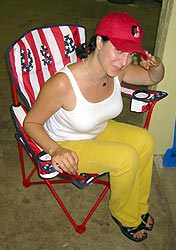 Rose: simultaneously showing her undying patriotism and expressing the irony of sitting on a flag that has been fashioned into a patio-chair with beer-cozies.
For me, however, it causes problems. I absolutely find it mind boggling to separate one event or thing or person from another. When I analyze situations and try to problem-solve, I find it difficult to put outer boundaries on the domain of the problem. I want to keep connecting everything to everything--leading me to endlessly complex and insoluble situations.
I became better at putting edges on things during my four years of practicing architecture, and during my two years at business school. It's no surprise--both architecture and industrial-age business theories (which, yes, are still part of the contemporary MBA) have at their core a mechanistic view of the world, one that encourages piecemeal analysis.
I don't want to define edges. I don't want to have my problems neatly encapsulated. (Well, maybe I want to, but it seems against my nature to do so.) As a result, I'll continue to live with my scale problems--perhaps some day they'll actually come in handy.