Now that we’re in a global recession, perhaps at the end of it the citizens of the world (particularly the first-world variety) will come to a new balanced perspective of how economic growth should fit into the total framework of human existence.
In the United States, as capitalists in general, we tend to focus on economic growth for its own sake. We see it as the bellwether of the nation’s health. However, economic growth should simply be one of many positive by-products of humanity’s striving to better itself and improve the quality of life for all.
The creators of the Genuine Progress Indicator metric have embraced this way of thinking for over a decade now. If, after all the current chaos subsides, we see a groundswell of support for this “new-old” way of thinking, I for one will consider the revised world-view worth the price.
Showing posts with label opinion. Show all posts
Showing posts with label opinion. Show all posts
I think I originally read Catcher in the Rye in 1992 or 1993--when I started college it was on my list of “books I should have read in high school but didn’t because my school was too religiously conservative.” Unfortunately, when I first read it I was in the beginning stages of architecture school, and was apparently too distracted by my new obsession (and the corresponding workload) to appreciate the full beauty of the story.
I just finished reading it again, and realized, interestingly, that Holden’s little sister Phoebe seems to be the spiritual twin to Esmé in Salinger’s earlier short story bearing that name.
I just finished reading it again, and realized, interestingly, that Holden’s little sister Phoebe seems to be the spiritual twin to Esmé in Salinger’s earlier short story bearing that name.
In Max's Kindergarten class, the current big thing is Star Wars: The Clone Wars on Cartoon Network. Toys 'R' Us is pushing it, everybody's pushing it. This is all fine, fine, when it comes to toys and costumes, etc. However, the show is quite violent, and I can't believe there are so many parents out there allowing 5-6 year olds to watch it.
Tags:
children,
education,
opinion,
television
Rose and I were having dinner with some friends last night--wonderful people--and the experience reminded us of what characterizes our social circle. We have a very mixed group of friends--different income levels, different political views, different cultural interests, different geographies, different ideas of what constitutes a good time...the list goes on. We tend to slice across personality types--many of the people we call friends wouldn't really get along with one another, even though they get along with us. Over time, we've observed that the single common thread that runs through the individuals and couples that we consider friends, and who remain friends over time, is the following set of characteristics:
- They have a reasonable amount of confidence about themselves,
- They have a genuine interest in other people,
- They have no agenda to deliver, no big chips on their shoulders,
- And nothing to prove to anyone.
Tags:
friends,
observations,
opinion,
philosophy
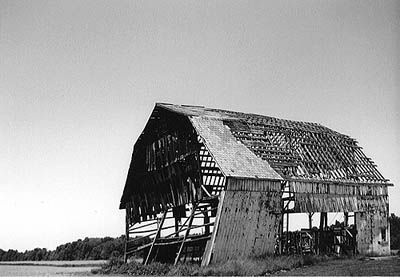
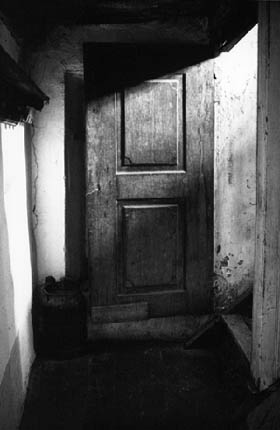
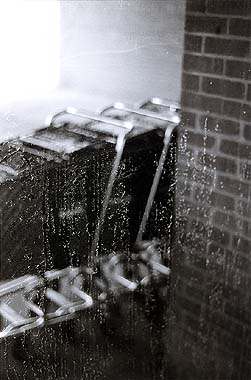
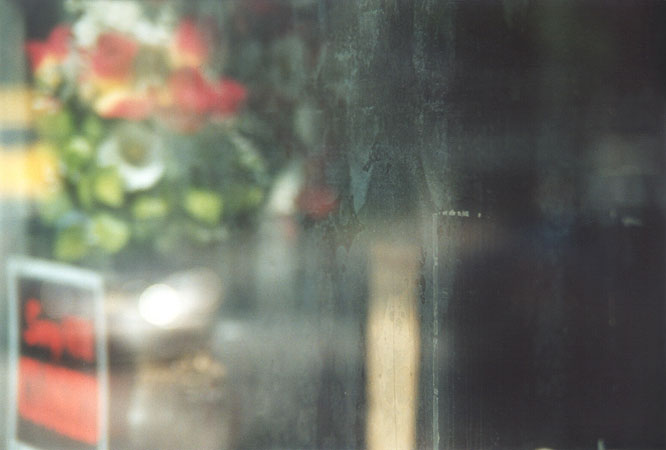
After fifteen years of using a Nikon FG to make photographs like this, this, this and this (the best image I’ve ever made), I finally decided to buy a digital SLR with a decent lens. In the process of bringing myself into 2007 in order to make an educated purchase, I found Ken Rockwell’s technical musings particularly helpful. However, as sharp as his technical workups of digital cameras are, I find his theory of “modern exposure technique” quite troubling:
For as much as he evangelizes the artistic seed of good photography, making points like “Why Your Camera Does Not Matter”, he seems to completely miss the artistic function of photographic variables like ISO, aperture and shutter speed. All of these variables represent creative choices that a photographer must make. Speaking simplistically, ISO affects the negative’s level of grain/noise; aperture (my personal favorite) affects depth of field; shutter speed affects how motion and light are captured in the negative. I would also argue that it is next to impossible to manifest one's creative intent consistently with auto-focus enabled.
I suppose this type of thinking shouldn’t surprise me as popular photography has now completely made the jump from film to digital, with the primary image-viewing venue being the internet (as opposed to the physical gallery). This shortcut thinking evidences itself in the deluge over-saturated, cliché “wow” shots that are consistently so popular on sites like flickr. Good photography consists of more than just wow-shots.
No longer does anyone need to worry about ISOs, apertures or shutter speeds; most cameras do this automatically. All you need to know is when to apply a little bit of correction to the camera's decisions, and you do this by looking at your LCD.
Modern exposure technique is optimizing the exposure compensation as needed, not setting exposure manually. The manual part is making the slight corrections to the automatic exposure, not setting apertures or shutter speeds as in the 1950s.
For as much as he evangelizes the artistic seed of good photography, making points like “Why Your Camera Does Not Matter”, he seems to completely miss the artistic function of photographic variables like ISO, aperture and shutter speed. All of these variables represent creative choices that a photographer must make. Speaking simplistically, ISO affects the negative’s level of grain/noise; aperture (my personal favorite) affects depth of field; shutter speed affects how motion and light are captured in the negative. I would also argue that it is next to impossible to manifest one's creative intent consistently with auto-focus enabled.
I suppose this type of thinking shouldn’t surprise me as popular photography has now completely made the jump from film to digital, with the primary image-viewing venue being the internet (as opposed to the physical gallery). This shortcut thinking evidences itself in the deluge over-saturated, cliché “wow” shots that are consistently so popular on sites like flickr. Good photography consists of more than just wow-shots.
Recently at Lifehacker there was a post entitled Why Renting Might Be Better Than Buying a Home, which linked to a pair of articles at the Millionaire Mommy Next Door blog discussing the merits of *not* being a homeowner. I made a comment that the author of the articles appreciated, so I thought I’d reproduce it here:
I am currently a homeowner (of a house I can easily afford--this is important), but I have always been a strong proponent of rental housing. Renters are sometimes considered second-class citizens in this country, and that is a real shame. A lease, although different than fee ownership, is still a bona fide interest in real estate. I would go so far as to say that renters-by-choice in the U.S. should be applauded in 2007 for being significantly more intelligent than their home-owning counterparts.
I feel qualified to comment on this since (a) I happen to work in real estate investment & development, (b) I am a homeowner, and (c) I have been a renter in the past many times over.
Speaking as someone who invests in real estate to make a living, let me say that a personal residence is about the only type of real estate that I would *not* consider an investment. It's a place to live, and it's an emotional transaction. As such, it is a bad investment.
A house is something you dump money *into*. A real estate (or any other) investment is something you pull money *out of*. Please note the direction of the cash flow.
Not only have I observed this to be true in my own life/career, but this advice has been affirmed by several other (much older than me) investment mentors, and I'm talking about people who know how to make money here, people with net worth containing 8 and more digits.
In the past several years, many people have been fortunate to see the value of their homes appreciate rapidly, especially those living on coasts. The lucky ones monetized this before the trend reversed. There are many people still left holding hot potatoes, as we are now all reading in the news.
Home equity should not be a major piece of your net worth. If it is, you should consider some 'portfolio re-balancing.'
Although I am a strong proponent of renting, I will admit that there is a significant emotional satisfaction from owning. And that's my point: Buy a house because you want to buy a house, not because you think it's better financially than renting.
I am currently a homeowner (of a house I can easily afford--this is important), but I have always been a strong proponent of rental housing. Renters are sometimes considered second-class citizens in this country, and that is a real shame. A lease, although different than fee ownership, is still a bona fide interest in real estate. I would go so far as to say that renters-by-choice in the U.S. should be applauded in 2007 for being significantly more intelligent than their home-owning counterparts.
Here Is The Correct Answer
For a long time I’ve felt just a little bit guilty about the fact that I criticize people who only like representational art. Usually, these people judge the quality of artwork by how realistically it depicts its subject matter. I’ve also traditionally been very critical of people who value highly sentimental artwork, much of which is popular in mainstream and commercial art venues. The reason I’ve felt guilty is because I’ve thought to myself, “Who am I to judge what someone else prefers?”
I’m tired of apologizing for being judgmental and didactic. No more—I think it’s just fine to be that way. I mean, if you never make any firm value judgments, how do you even know who you are?
This past weekend, Rose, some friends and I visited a very interesting gallery that was assembled inside an old sawmill. Unfortunately, the architecture of the gallery was where the interest ended—every piece of work inside was a detailed rendering of a landscape, a portrait of someone, an automobile, or a street scene. All of the work was fairly well executed, but where was the soul?
Purely representational artwork is often nothing more than an artist showing off—it is a display of technical expertise—it is illustration. I like abstract work better—wait, let me rephrase that—abstract work is better—because it allows for the viewer’s own interpretation of the meaning of the work. It allows, and encourages, the viewer to think. When I look at a portrait or a landscape I think, “Oh, there’s a portrait [or a landscape]. I like the colors. Neat.” And that’s it—end of brain use. When artwork is simply pretty it is not art—it’s craft. Craft has a place, but don’t call it art.
To summarize: Abstract artwork is better than perfectly representational craft. Representational craft pieces can sometimes be redeemed (and actually called art) if they have an interesting narrative or extraordinarily unique style. If you disagree with me, you are wrong, and how do you like that [tongue stuck out]?
When I was growing up, my parents didn’t seem to think about the moral implications of the place they chose to live. In general, there seemed to be little worry about sprawl, traffic congestion, and many of the other urban issues that concern us today.
Oh, wait, I take that back…there was one big one: it was considered wrong to live in the city. In the late 70s and early 80s, growing up in rural/suburban America, the image of the city was that of a dangerous, sinful place. It was full of crime, traffic, congestion, people of a bad influence, and strangers with candy.
Today, many urban protagonists (such as myself) deride the suburbs as being environmentally and socially irresponsible, dysfunctional (à la American Beauty), exclusive, isolated and out of touch. Yes, many of these concerns are justified. But are we being too critical? Are we, the brave young urban pioneers of Middle America, being just as judgmental as the suburbanites were a decade or two ago?
Subscribe to:
Posts (Atom)